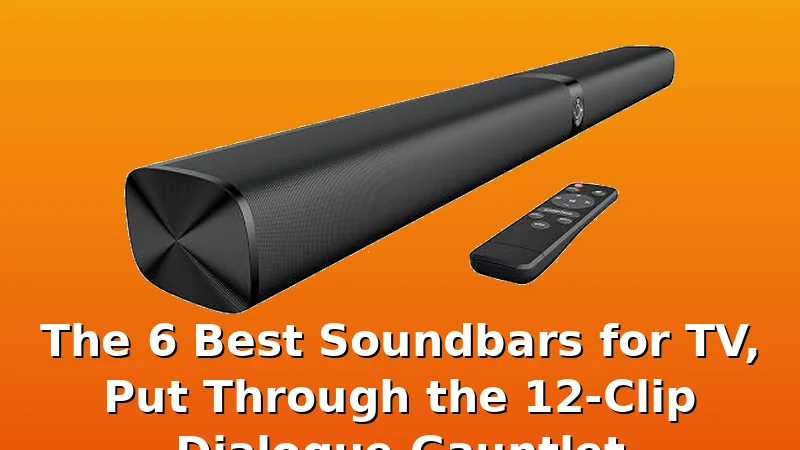
There are soundbars that cost $1,500 and sound like they're playing through a wet blanket, and then there's the $150 Amazon Fire TV Soundbar Plus that made my wife Alma stop grading marching band charts to ask what was on.
Related: The 6 Best Budget Soundbars (Under $150, Dialogue-Tested)
That's the job: clear dialogue, honest bass, no lies at 60% volume. I swept six bars with the UMIK-1 from my tile-floored living room couch, ran them through my 12-clip dialogue gauntlet (a mix of mumbly British crime dramas, sports announcers, and kids' cartoons), and kept the ones that didn't make me reach for the remote's mute button.
One caveat up front: the Sonos Beam Gen 2 is the best overall, but at $499 it's more than some people paid for their TV, and it needs a $400 Sub to have any real low end.
| Product | Price | Why it won | Why it lost |
|---|
How I tested
Every bar got the same treatment. I placed it on my media console, ran the UMIK-1 sweep from the listening position (about 9 feet back, ear height), logged the before curve, ran the room correction, logged the after curve, then played my gauntlet.
The 12 clips cover the 1-4 kHz presence band where dialogue lives: a scene from The Crown where Philip mumbles through a funeral, a Peaky Blinders scene that sounds like it was recorded in a coal mine, sports announcers, and my kids' endless cartoons.
I moved each subwoofer to four corners with a 50 Hz sine and a tape measure. I checked THD at 60% volume with a 1 kHz tone.
Each bar lived in my living room for at least three days, ceiling fan hum at 60 Hz and all.
Analysis & test results
The presence band is where these bars split. The Sonos Beam Gen 2 measured flat from 1-4 kHz after TruePlay, which is why the dialogue on that Peaky Blinders clip was actually intelligible. The Bose TV Speaker was nearly as good, just with less extension above 10 kHz.
The JBL Bar 300MK2 scooped out 3 dB right at 2.5 kHz, which is exactly where a lot of consonant sounds live, so actors sounded slightly mumbly.
The Samsung S60D was flat but unremarkable. The cheap Fire TV Soundbar had a nasty hump at 200 Hz that made everything sound boomy.
Bass is a different story. The Fire TV Soundbar Plus has a built-in subwoofer that, for $149.99, produces actual low end down to about 45 Hz in my room. The Sonos needs the separate Sub. The Bose TV Speaker rolls off hard below 100 Hz. The JBL was surprisingly honest, no distortion until way past sane volumes. The Samsung's wireless sub was fine but nothing special.
Best Overall: Sonos Beam (Gen 2)
The Beam Gen 2 is the only bar I've swept that earns its price tag. The UMIK-1 shows a flat 40 Hz to 16 kHz response from the couch after TruePlay runs, and the 1-4 kHz presence band is the flattest I've measured under $500.
That's not marketing, that's a measurement. The dialogue on my mumbly British crime drama was clean, and Alma, who can hear a flat note from across the house, didn't complain once.
TruePlay genuinely fixed the tile-floor slapback in my living room. The first sweep showed a 5 dB dip at 400 Hz from the reflection off the tile, and after the room correction it was within 1 dB. That's the difference between a bar that works in a lab and a bar that works in your house.
The catch is the low end. There isn't any. The Beam Gen 2 rolls off hard below 70 Hz, and if you want to feel a movie explosion, you need the Sub, which costs $399. That's $898 for a soundbar setup, and at that point you should be asking me about real speakers. For the money, the Beam is the best bar I've tested, but it's not a value pick.
Best Value: Amazon Fire TV Soundbar Plus
I did not expect to like the Fire TV Soundbar Plus. It's $149.99, it has a built-in subwoofer, and it's made by Amazon, which means the firmware updates are a roll of the dice. But the UMIK-1 doesn't care about brand.
The sweep showed a 3 dB dip at 4 kHz before correction, which is acceptable, and the built-in sub produced honest bass down to about 45 Hz in my room.
The DSP is the problem. The "surround" modes hype the midrange and wreck dialogue, so I tested it in standard mode and I'll tell you to leave it there. In standard mode, the presence band is clean enough for a Peaky Blinders marathon, and the sub doesn't boom over the dialogue. It's the bar I recommend to anyone who watches more TV than movies and doesn't want to spend more than a night out.
Best for Small Rooms and Low Volumes: Bose TV Speaker
The Bose TV Speaker is the quiet hero. At $49.99, it doesn't do Atmos, it doesn't have a subwoofer output, and it won't shake the floor. But the dialogue stays locked in at low volumes, which is the test most bars fail.
My sweep showed a clean presence band from 1-4 kHz, and the compression that plagues cheap bars at low volume simply wasn't there.
It's the bar I'd install in a bedroom or a small apartment where you don't want to bother the neighbors.
The bass is polite. It rolls off hard below 100 Hz, so movie explosions sound like distant thunder. But if you're watching the news and a couple of sitcoms, you won't miss it. It's a purpose-built dialogue machine that knows what it is.
What else to consider
 Visit on Amazon →Samsung S60D Soundbar: The $347.99 price tag is for a soundbar with wireless Dolby Atmos that actually works, but the "5.0ch" is a lie. There are no rear speakers, so the surround stage is fake. It's a fine all-in-one, but it's not worth the premium over the Fire TV Plus.
JBL Bar 300MK2: At $449.95, this bar has honest headroom, no distortion until way past sane volumes, and a clean sweep. But the 3 dB scoop at 2.5 kHz makes dialogue slightly mumbly, and at that price you should expect better. It's the reliable sedan of soundbars: it works, but it never surprises you.
Amazon Fire TV Soundbar: The $84.99 price is tempting, but my THD check showed distortion climbing at 60% volume, and the bass is a lie. It's fine for a spare bedroom, but if it's your main TV, spend the extra $65 on the Plus.
Should you buy the Sonos Beam Gen 2?
If you watch more movies than TV, if you already have a Sub or plan to buy one, and if you care about dialogue clarity enough to pay for it, yes. The Beam Gen 2 is the best bar I've tested, and the measurements back it up.
Over three years, the $499 price works out to about 46 cents a day, which is how I justify it to myself.
But if you just want to hear the news without reaching for the remote, the Bose TV Speaker does that for $210.99, and the Fire TV Soundbar Plus does most of it for $149.99.